
MOWMT 26: Diving into the Details with Lisa Rogers

It’s All in the Details by Lisa Rogers
Precision in writing can be hard-won. As writers, we can get carried away by our words, without making sure that each one communicates what we intend. Sometimes, as we slice a story to lower word count, we clip the very words that add specificity and meaning.
How can you add details without overburdening your story? By imbuing each sentence with specificity. Using figurative language, sensory detail, and the sounds of words can set up the reader for your story, immerse the reader in setting, spark connection, and create a clear mental image. A writer’s job is to place readers in the story so they experience that world as they turn the pages.

Setting and Pace
Woody’s Words: Woodrow Wilson Rawls and Where the Red Fern Grows by Lisa Rogers, illustrated by Susan Reagan (Calkins Creek/Astra, 2025) opens with a metaphor: “For young Woody Rawls, school was the farm near Scraper, Oklahoma, where he grew up in the early 1900s. It was the river where he fished, the woods where he hunted, and the fields he helped harvest.” Woody’s childhood was crucial to his storytelling, and the authenticity of place is apparent in his work. I aimed for an unhurried pace to complement Rawls’s writing and speaking style, and used quotations throughout so readers could hear his voice. Woody achieved his writing dreams through keen sensory abilities. Noticing is something every writer should work at.

Authenticity and Resonance
In The Princess and the Grain of Rice, by Tina M. Cho, illus. by Honee Jang (FSG, 2026), Cho rejuvenates and reimagines a princess and the pea story, setting it in Korea and basing it on a traditional princess test. Questions and answers taken by a real princess create a far deeper meaning and resonance. “Jeongsoon took a moment to consider the question. She pondered about her dreams, her thoughts, her fears, the things she kept buried in her heart.” Readers feel like they know Jeongsoon because of that authenticity and resonance.

Figurative Language and Emotional Connection
In The Ocean Calls: A Haenyeo Mermaid Story, also by Cho, illus. by Jess X. Snow (Kokila, 2020), I was struck by author Tino Cho’s opening: “Dayeon and Grandma stretched and watched the sun’s first rays kiss the sea.”
That personification helps us infer their close relationship—as they together welcome the sunrise—but readers feel it, as warm and tender as the sun gently spreading its light on the water. This grandmother has an affinity to the water itself—the kissing of the sea is reverential, and we watch them honor that sunrise and their mutual bond. The consonance of those s’s—“sun’s first rays kiss the sea”—adds to that reverence. Dayeon wishes that she, too, could love the ocean. Because Cho immediately creates the story’s warmth, the reader feels confident that Dayeon will earn her wish.

Connection
The World Entire: A True Story of an Extraordinary World War II Rescue by Elizabeth Brown, illus. by Melissa Castrillón (Chronicle, 2025) focuses on one man’s humanity and care for others. Aristides de Soua Mendes saved tens of thousands of lives during World War II. We first see that care through a humble but telling detail: “On Thursdays, Aristides opened his kitchen to the children of the town. The town wasn’t a wealthy place, but Aristides’ door was always open. He baked bread and made soup and served them at his table on chilly days.” Brown tells us not only what Aristides served, but even the day that he fed these children. We know something specific and vital about Aristides, and that gives the reader hope throughout the story.

Poetry, Consonance, and Setting
When Twilight Comes: The Animals and Plants That Bring Dawn and Dusk to Life by Marcie Flinchum Atkins, illus. by Michelle Morin (Chronicle, 2026), Atkins’s nonfiction narrative uses poetic language to precisely describe plant and animal activities during morning and evening twilights, allowing readers to learn about each and visualize each scene: “After scavenging all night,/ the opossum, full of insects and fruits,/saunters back toward her den,/her nose to the ground/for a fallen apple for her young/before the sun’s shine dims her sight.” Atkins’ use of s ties the scene together and quiets the moment.
Mental Images/Sensory Detail
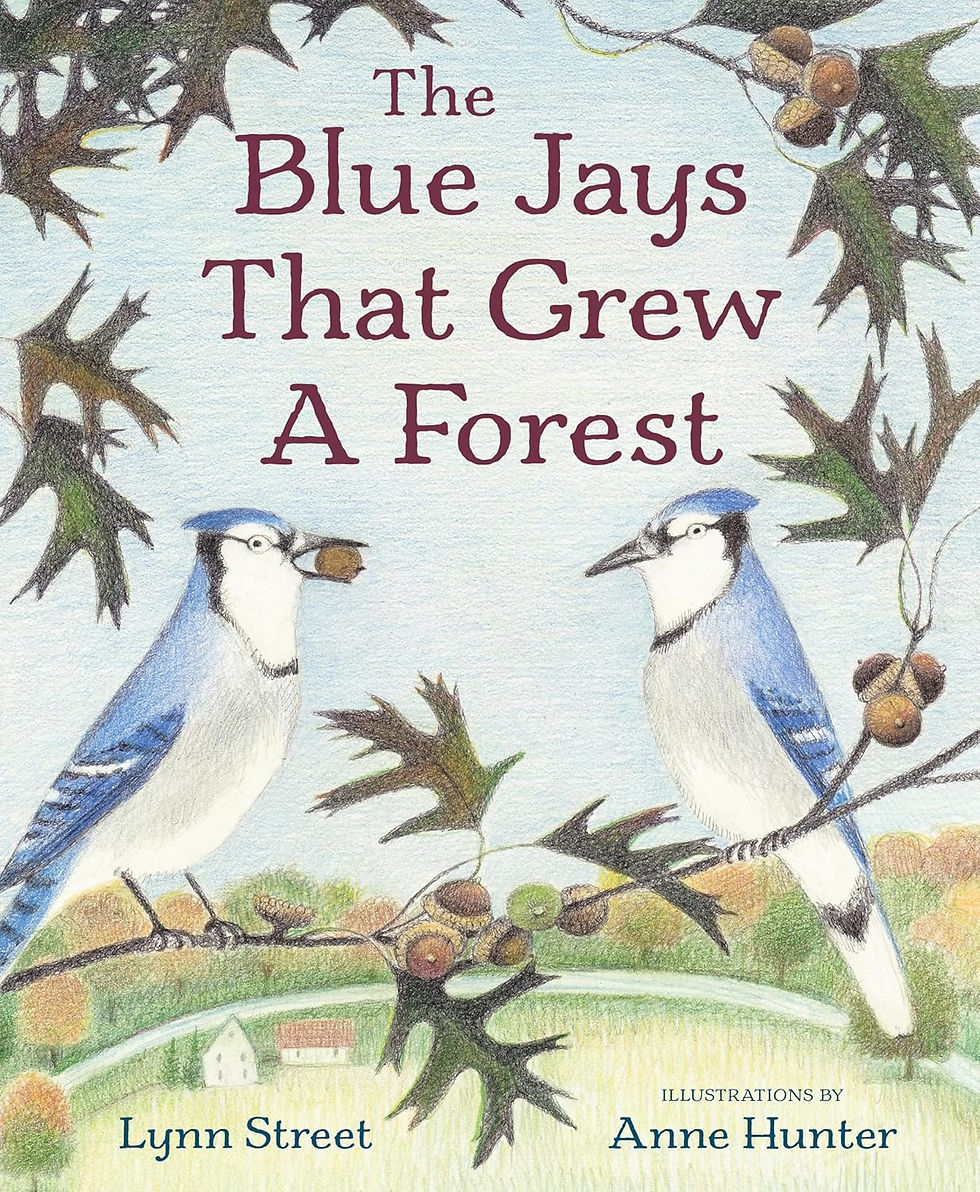
In Lynn Street’s The Blue Jays That Grew a Forest, illus. by Anne Hunter (Margaret Quinlin Books/Peachtree, 2025), a jay “pulls and pries an acorn from the tree, holds it with strong feet—hammers it open with its beak.” Specificity lets us feel that process: the pulling, the prying, the tensile force. Readers are right there in the oak with that jay.
Street’s similes create strong connections and mental images, and the sounds of words hold meaning, too: “acorns fall like hailstones pummeling the dirt.” Pummel packs power: that hard p and repetition of the l create a cadence that helps us hear and feel how hard those acorns fall and gives us a sense of their weight.
Details matter. The ones you choose can create stories long remembered by readers.
PRIZE: A signed copy of one of Lisa’s books.

LISA’S BIO: Lisa Rogers is the award-winning author of Woody’s Words: Woodrow Wilson Rawls and Where the Red Fern Grows, a Texas Topaz Reading List selection; Joan Mitchell Paints a Symphony, called “simply marvelous” by Kirkus in a starred review and a Eureka! Honor book; Beautiful Noise: The Music of John Cage, which earned three starred reviews, the Golden Kite Honor Award winner for Nonfiction Picture Book Text, and the Julia Ward Howe Notable Book Award; 16 Words: William Carlos Williams and “The Red Wheelbarrow,” which received two starred reviews and was called “a fine introduction to a celebrated American poet” by The New York Times; and the bestselling Elvis Presley: A Little Golden Book Biography.
Other works: the rhyming picture book Hound Won’t Go; Ronald Reagan: A Little Golden Book Biography; Discover Her Art: Women Artists and Their Masterpieces; and the title poem in If I Could Choose a Best Day (Latham and Waters, eds.). A former news reporter, editor, and elementary librarian, Lisa is an author advisor for The Writing Barn’s Verge program and lives near Boston.
CONNECT: lisarogerswrites.com

BONUS ENTRIES: NOTE: As you comment on each post, please note whether you have shared this post, bought the author's book for yourself or as a gift, whether you have followed our guest blogger or Rate Your Story on social media (and where), as well as whether you have left a review of the guest blogger's book (and where) for extra entries (for each show of support) and to be eligible for surprise prizes.
Feel free to click the links to buy the books mentioned and help support our Weekly Mentor Text Talks (OPEN TO ALL - Replays available to Rate Your Story Members only)! Thanks for sharing the #BookLove #MarchOn #MentorTexts #RateYourStory


Love this post. Thank you, Lisa. I'm writing 'specificity' above my computer so I never forget!
This is a luscious, exciting post. Thanks, Lisa.
PS I love 16 Words.
I love all the elements contained in the mentor texts you offered. Language and word choice can have a vast influence on voice, pacing, tension, etc. Thank you for this informative post!
It's so tempting to leave out details when you're watching your word count. Thank you for the reminder that the details are what really immerses your reader in the story.
"Using figurative language, sensory detail, and the sounds of words can set up the reader for your story, immerse the reader in setting, spark connection, and create a clear mental image." - This all really resonated with me and I enjoyed the variety of mentor texts presented.